Coachman
He cared for carriage horses, harnessed correctly, knew the roads and planned safe travel, feeding and rest.
From the estate's living source of power to the documentary trail that may connect Kaktus of Inczew with Alli, the horse ridden by Olympic medallist Kazimierz Szosland.
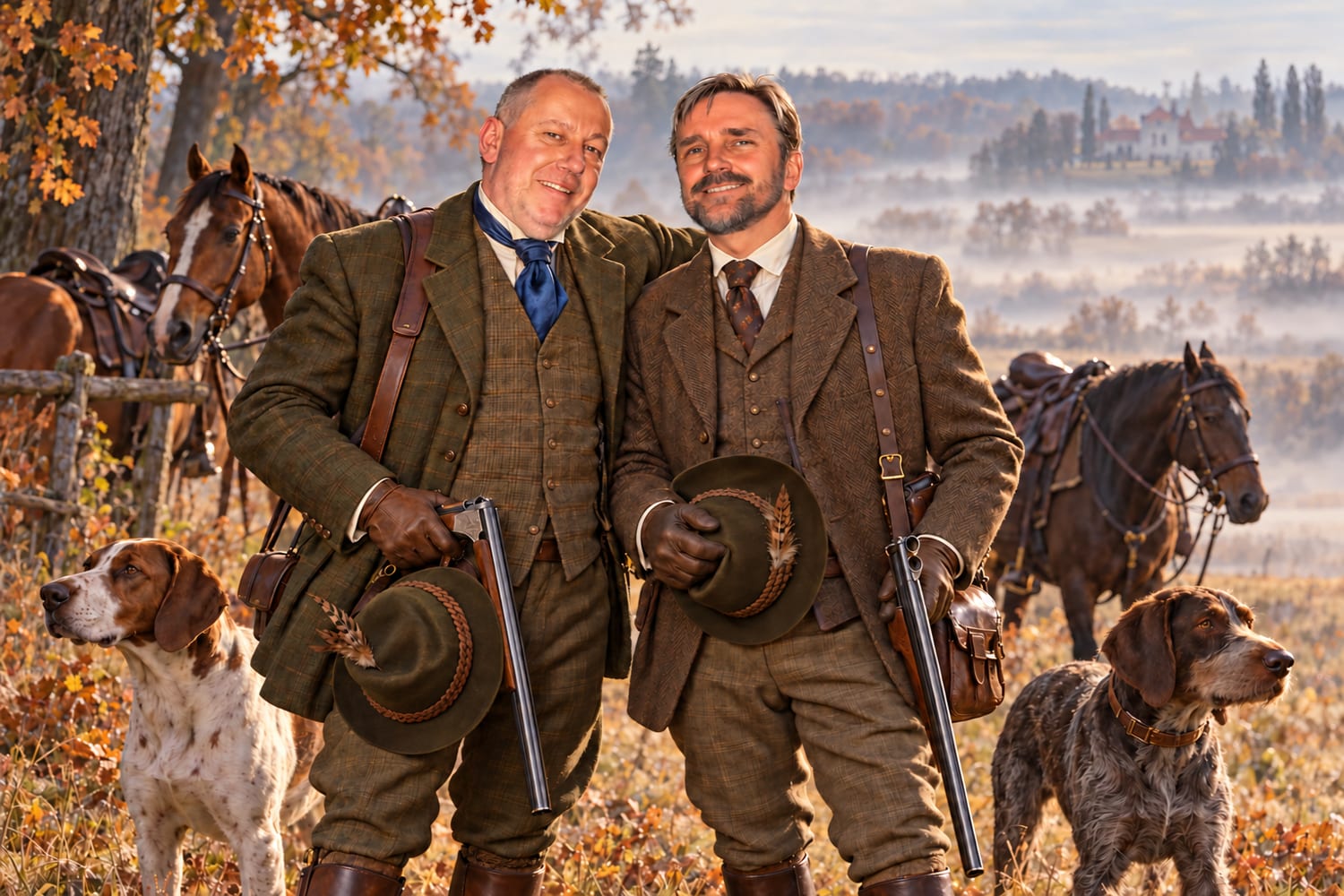
This reconstruction was created for the portal. It is not a documented view of the Inczew stables or a portrait of Kaktus/Alli.
Before combustion engines transformed farming, horses set almost every part of an estate in motion. They ploughed and harrowed fields, hauled grain and timber, and carried the family to church, a doctor or the railway station. A horseshoe in the virtual Walewski Drawer therefore opens a much larger story about buildings, crafts, people, animals and the birth of modern equestrian sport.
A sound stable had to protect horses from cold, damp and draughts while providing ventilation. It needed stalls or boxes, mangers, safe floors, working aisles and a practical way to remove manure. Hay, straw and oats had to be kept dry and protected from fire and pests. A larger complex could include a tack room, coach house, store and forge.
The day began before the first journey. Each horse was fed, watered, groomed and examined. After work, tack was removed, legs and hooves checked and a wet coat dried. Neglect could cause suffering and lameness, but it could also stop essential work across the estate.
He cared for carriage horses, harnessed correctly, knew the roads and planned safe travel, feeding and rest.
They knew each animal's temperament and supervised feeding, cleanliness, exercise and preparation.
He handled teams during ploughing, harrowing, harvest transport and other heavy farm work.
He joined knowledge of metal with a practical understanding of the living hoof and movement.
Harness transferred an animal's power to a vehicle. It had to be durable, correctly fitted and regularly maintained. The estate required heavy carts for crops and materials, while the household used light carriages and more formal vehicles. Horses also consumed meadow, oats, straw, water, labour and veterinary attention; manure returned to the fields and completed the agricultural cycle.
A breeder selected mare and stallion with conformation, temperament, health and intended use in mind. A farm horse, elegant carriage horse and sporting mount required different qualities. No complete studbook or breeding programme for Stefan Walewski has yet been located. What survives is a precise published lead linking Inczew to international sport — strong enough to investigate, but not to erase the remaining uncertainty.
Both records must remain visible. A studbook, military purchase record or another contemporary primary document is needed to settle the matter. There is also a disagreement over the year of birth: 1920 in the Polish equestrian account and 1917 in Olympedia. The notation Kaktus → Alli is therefore a research hypothesis, not a substitute for the missing document.
Kazimierz Szosland served in the Polish Army and became a leading rider, instructor and organiser of military equestrian sport. In Amsterdam, Szosland and Alli joined Kazimierz Gzowski on Mylord and Michał Woysym-Antoniewicz on Readgleadt to win team silver in show jumping.
According to the Polish Olympic Committee, Szosland and Alli placed thirteenth individually among 46 starters, with a time of 1:40.0 and two penalty points. The same round counted towards the team result. The FEI lists the horse as “Ali”; Polish equestrian sources usually use “Alli”.
Country-house hunting combined management of game, physical activity, prestige and sociability. Horses could transport participants and support the organisation of a hunt. This does not prove that every familiar ceremony took place at Inczew. An invitation, photograph, diary entry or newspaper report would be needed to document a specific event.
At the turn of the twentieth century, horses belonged both to an old world of transport and farm work and to a new world of racing, show jumping and organised training. The Kaktus–Alli trail shows this transition while preserving the boundary between Alli's documented career and the still-unconfirmed Inczew pedigree.
Szosland's Olympic start on Alli, thirteenth place individually and team silver at Amsterdam. Modern equestrian studies publish the Kaktus and Inczew connection.
A primary source completing Kaktus → Alli, a studbook or pedigree, an unambiguous year of birth, transfer to the army and date of the name change.
We are also seeking a plan or photograph of the Inczew stable, inventories of vehicles and tack, and the names of the people who cared for the horses. Open questions show readers how historical knowledge is built and why honest research differs from legend.